
Intro to Rational Enlightenment
Spiritual fulfilment without losing your mind.

Three years ago at Cambridge’s MBA program, I had a series of conversations that bothered me. These were with some of the highest-achieving people I’d ever met. They worked in organizations with names that would make you raise your eyebrows and had salaries that might cause your eyes to bulge. But somehow, many of these people felt unfulfilled. Billions of people would consider their prayers answered if only they had the level of success these people had, but these people felt like something was still missing.
This series of posts is aimed at solving this dilemma. It’s for people that are successful on paper but still are searching for answers. Furthermore it’s for those same people that are not interested in trying to find the answer via religion, astrology, “energy”, or unscientific beliefs.
How have I met people living in extreme poverty in Cambodia that are far happier than these successful people at Cambridge? Is having big dreams or ambitions a problem? Is being successful actually an issue? Do you ultimately have to adopt some sort of spiritual woo woo in order to ever feel truly fulfilled? Happily, the answer to these questions is an emphatic no.
Instead, the root cause is a fundamental misunderstanding most high achievers have about how happiness and fulfillment actually work. This series addresses that misunderstanding via the four steps outlined below. It takes some (secular) ideas from Buddhism, but instead of guiding you towards a move to Tibet to chant as a monk for the rest of your days, it adds some constraints and a structure that allows the wisdom to be integrated into a professional’s normal life. It’s not about giving up your goals. It’s about finally feeling fulfilled while pursuing them.
Summary of Rational Enlightenment (and map to this series of posts):
Realize that happiness is immediately available
The Argument (this post)
The Balance: Rational Enlightenment. How to diligently work at your purpose and be very happy.
If that summary doesn’t make any sense, don’t worry. The following posts will explain each step in detail and the hope is that by the end, dear reader, you will have all of the information you need to be filled with joy and, almost ironically, be on a far better trajectory to reach your full potential.
Step 1: Realize that happiness is immediately available
There are two components to this step:
The logical argument
The capability
This post is a deeper dive on the logical argument. In line with the “without losing your mind” tagline of this post, I want to show how we can arrive at the conclusion without any spiritual woo woo.
If you agree that happiness is immediately available, you can skip to the next post on gaining the capability of immediately feeling it whenever you like. Additionally, if you get halfway through this post and “get it” feel free to move on to the next post. This post goes into a lot of objections as it is targeted at traditionally moderately successful people who will likely be very defensive of having desires (that will make more sense later).
If you’re still here and you’re not sure if happiness is immediately available or even disagree, let’s begin by defining happiness.
What is happiness?
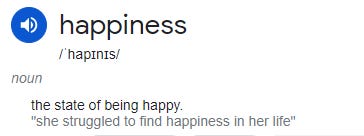
Okay… what is happy?
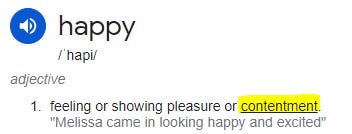
Okay… what is contentment
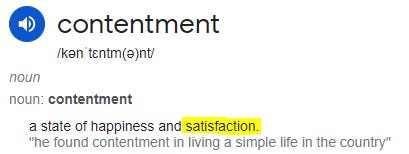
Okaaaaay………….. what is satisfaction?
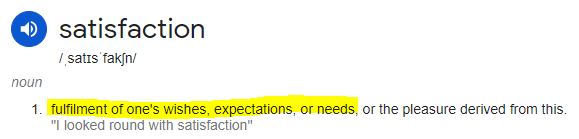
So happiness = a state of pleasure / enjoyment / contentment. Contentment = satisfaction = fulfillment of one’s wishes, expectations, or needs. In other words, happiness is the fulfillment of our desires (the things we want, expect, or feel we need).
If this is true, to achieve complete happiness, everything you desire would need to be fulfilled. If you want to end up at the head of your company, the next promotion will be nice, but you can never be completely happy until you are CEO. If you expect your life partner to notice and praise all of the improvements you’re making on yourself and give you a certain amount of attention, their intermittent compliments will be pleasant, but you’ll never be truly happy until they start praising you to the extent you desire and expect. If you desire the perfect body and that new car, you won’t be happy until you get them…….. Right?
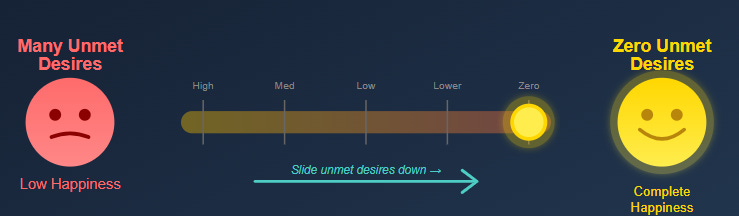
With this definition of happiness, true or complete happiness seems like it would be impossible. It seems unlikely that our desires would ever be 100% satisfied…. unless….
Unless… we attack the problem from the other side. If the goal is to fulfill all the desires we have (happiness) could we make that task easier by eliminating the amount of desires we need to fulfill? We could make achieving happiness more realistic if we whittled down the list of desires to something manageable. But wait a minute, what if we took that to the extreme and eliminated all our desires? Wouldn’t that technically achieve happiness by our definition? If there are no desires left to be fulfilled, if there’s nothing outstanding, wouldn’t that mean you’re satisfied and in a state of contentment, i.e. happiness?
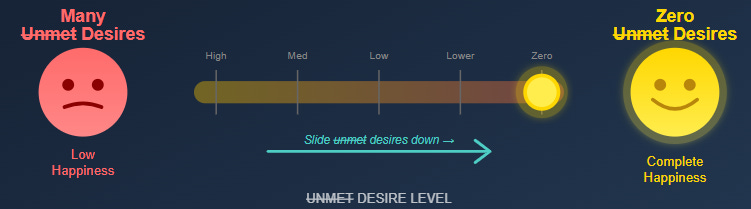
Conceptually yes, but the thing that you probably don’t believe, and that is laid out in the next several paragraphs, is that this is also true beyond mere wordsmithing!
Anyone familiar with Buddhism will instantly recognize this kind of thinking.
So the claim is no desires = happiness. Please remember that I am not saying that this is how people should live. I’m breaking with the 100s of years Buddhist tradition that says we should be eliminating all our desires (hence the rational in Rational Enlightenment). You can still keep all your desires. I’m not asking you to change a single thing about your life -- this is merely a thought exercise. You’re brave, so engage with the claim. If you’re still hung up, read the “BUT”s in the box below and then come back here.
Once again, the claim is (only) that no desires = happiness. Let’s take a generic example: someone in their early 30s is unhappy because they are single (against their will). Every other aspect of their life is great: career, meaning, friends, family, etc., but they, for some reason, can’t get this one thing they want. If there were a magic wand their friends could wave when they start complaining about it over drinks for the 20th consecutive weekend that magically removed - completely - this desire from their mind, what would happen? Would the person still be unhappy? …hopefully you see that the answer is no. They would be equally happy if they were suddenly un-single as they would be if they suddenly genuinely stopped wanting to be in a relationship (please assume this is a genuine cessation of desire, not lying to themselves).
(Side note: I find it interesting that we seem to have this knowledge inside us already. We know the way to save face is to pretend we didn’t want something when we don’t get it.)
How about something a little tougher. How about someone is unhappy because they’ve been diagnosed with a disease that gives them only 1 year to live. If you look at it closely, the reason this is so devastating is because people want to continue living. This is an absurd example to prove a point, but if this person didn’t have the desire to live beyond one year, this diagnosis wouldn’t phase their happiness. Once again, again, please focus on the truth of the situations presented rather than the likelihood that they arise. You’re right, it’s highly unlikely that anyone would not want to live past a year. But that’s not the point. The point is that if they DID exist, their lack of desire (to continue living) would make their happiness impervious to any terminal diagnosis. And so it is with all desire and all situations.
Go ahead and think of any situation; it can be as terrible as your imagination is capable of conjuring. Throw a Buddhist in there. If they practice what they preach - being free from desire - they can be happy. Okay, for all of you that imagined extreme pain, we’re going to make this a super-Buddhist who has full control over their desires. To prove a point, this fictional super-Buddhist would be happy even being tortured. If they truly eliminated their desire to not be tortured or to not feel pain.
It’s the desire that frames the entire outcome. A story of Jesus being whipped is often used as an example of sacrifice, because no one likes to be whipped…. except masochists. In fact some people will pay money to be whipped. It’s all about the desire. Most people have the desire to not be whipped and would be very unhappy in that situation. But masochists that don’t share that desire remain completely happy if the prospect comes up.
Take a minute to think through your hesitations that are keeping you from accepting that freedom from desire guarantees happiness. “But what about _______ situation?” Think about it. There’s a desire in there. Not happy because:
I’m overweight → Desire to not be overweight
Unrest in the middle east → Desire for peace
The wage gap → Desire for equality
I’m hungover → Desire to feel well
Of course all these desires are completely natural (and arguably should be desires), but the point is if that desire didn’t exist the “reason” for your unhappiness would no longer be valid. Take a minute to think through your hesitations.
.
.
.
Don’t move on until you accept the facts in these unrealistic thought experiments. You can take solace in the fact that these situations are all unlikely in the real world. For now you can accept that in these crazy or magical situations the logic holds up, but that you’re unconvinced for the real world or for you personally.
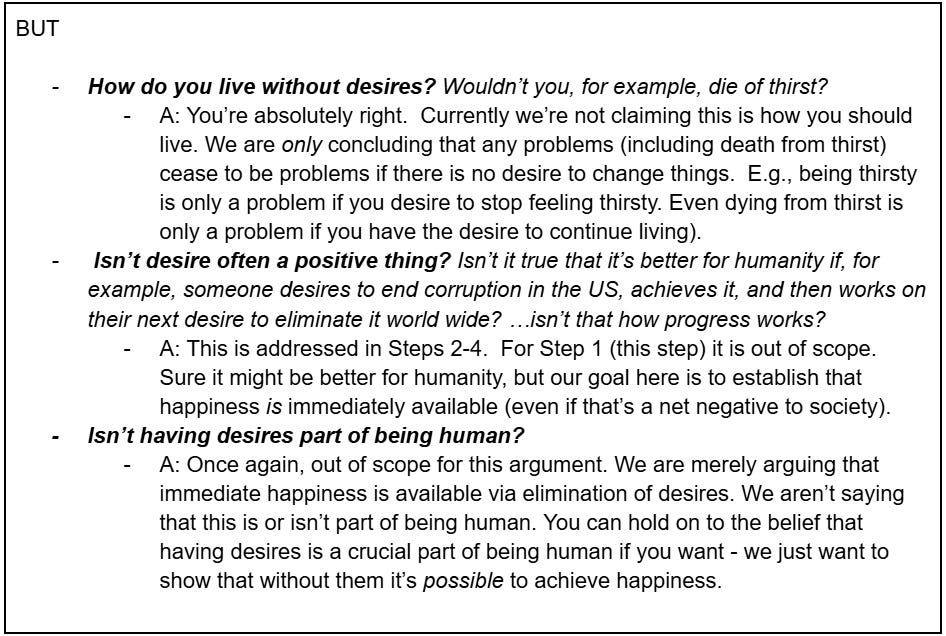
Okay, so we can now conclude that if you are able to eliminate desires, happiness is immediately available. Great - but the very obvious next question is how do you actually eliminate desires in practice? For some, the knowledge above is enough to get them there. For the rest of us, happily, there are a lot of people who have done a lot of work on this topic. Some of it has trickled into the western professional’s zeitgeist (“mindfulness,” “meditation,” etc.) but targeted, pragmatic, useful versions still seem to be unknown (I think this bears out in the vast majority of people that try mediation/mindfulness quickly reverting to their meditation-free lifestyles).
In the next post I will go into detail into how anyone can develop this capability so they can, on a whim, immediately feel completely happy.