
Step 4: The Balance (Rational Enlightenment)
You can have it all.

At this point in this series of posts, we’ve now looked at a fundamental spectrum from multiple directions. Depending on the lens, it shows up in a few different ways:
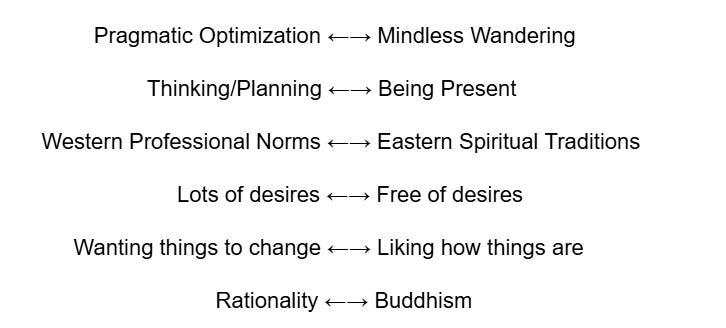
We’ve zoomed in on the ends of the spectrum and seen the truth for each. In Step 1 we outlined the ancient wisdom of the Buddhists and established that happiness is immediately available if we cease to desire. In Step 3 we showcased a pragmatist worldview that treats your entire life as an optimization problem - getting to our true objective (more commonly referred to as a passion), beyond happiness, biological impulses, or cultural programming. I suspect that most readers, by this point, realize that taking either of these to the extreme is not desirable.
Let’s start with the Objective Function end of the spectrum. It is easy to see how this can lead to feeling behind, perpetually reaching milestones but always discovering that there are more, and burnout. I surmise that many of the working professionals that started reading this blog came from a similar worldview, looking for something more enjoyable or fulfilling. This seems to be pretty common in Western societies.
On the other end of the spectrum is the Buddhist ideal of perpetual presence and living free from desire. This sounds nice, but it can of course become naive or idealistic - especially when viewed through the lens of someone who has been raised in a Western culture. Being completely present and accepting everything doesn’t integrate well into most modern societies. You don’t see many monks in your office building and most people don’t find themselves in situations where meditating in monasteries for the rest of their life or chanting 10 hours a day is realistic.
So what’s the answer?
Probably not what you think
As you already know from the title of this post, the answer is balance. But go ahead and guess where that balance is.
.
.
.
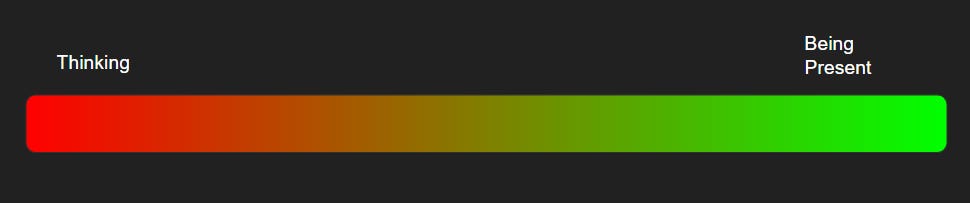
If you’re reading this, I’ll predict that your guess is far too close to your habitual mindset. Visualized below are the two ends of the spectrum we’ve discussed as well as my claim for where the right balance is.
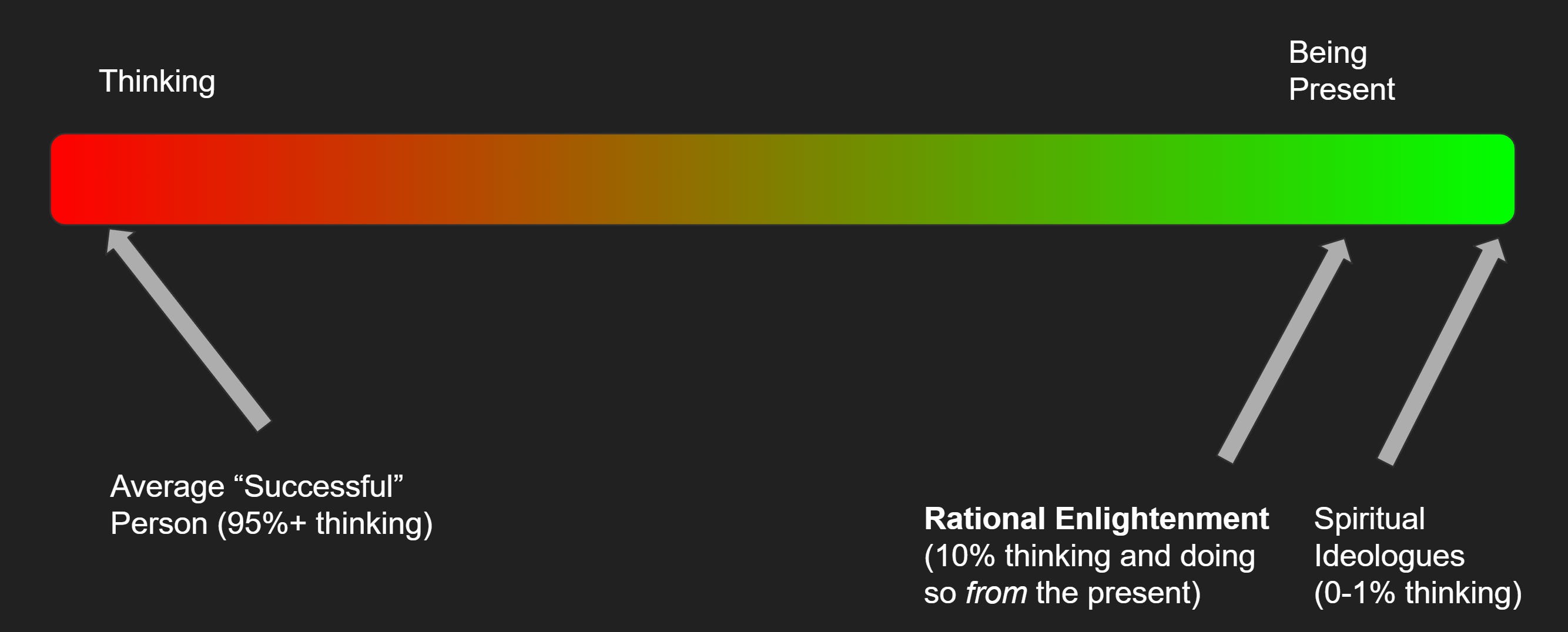
Some people may assume that the “balance” will be something like a 50/50 split of keeping your old habits/ways of doing things, but it’s important to realize that it’s much more significant. As an average successful person, being 90% present is changing your default state. Instead of being a busy working professional that occasionally attempts to be present, you’ll be someone perpetually thriving in the present that uses abstract thinking/goal setting/desires when they’re relevant/useful.
You don’t need to fixate on the 90%; 89% or 91% are not going to cause any dramatic damage. The important parts are (1) how different it is from your default state and (2) that it is far enough from the spiritual ideologues to remain rational.
How does improvement (or anything) happen?
Most professionals I’ve introduced these concepts to have a strong resistance to not needing to do anything. They - understandably - worry that if they truly embrace being present 90% of the time, progress will stall out, they won’t get enough done, won’t ever do anything important, or even in this paradigm, won’t realize their Objective Function.
The old paradigm looked like this:
Miss effort —> Self Judgement —> Urgency —> Action
The fear is that the new paradigm looks like this:
Miss effort —> Acceptance —> Stagnation
The truth is that effort is needed if you want your values or your Objective Function to be manifested. That’s just basic causality. However, since wanting your values to be manifested is not needed (so you technically still don’t need to do anything), accomplishing high-effort challenges would mean you choose to commit to them. Choose to work hard.
If you’re already worrying about stagnation, it’s pretty likely that you will want to choose to work hard and therefore overcome your worry. In other words, being worried is a sign that you probably don’t need to be worried. The part that might be confusing you is that if someone else chooses not to work hard, that is okay. They have different values than you, or have the same values but choose not to manifest them.
Some readers may wonder what happens if you choose to commit and then miss a commitment? Doesn’t this result in the same “not good enough” unconscious fear/anxiety in a new form? It could easily slip to that if you’re not careful. A healthy, Rationally-Enlightened alternative is to use a missed commitment as data. You’re still committed to {insert Objective Function or other commitment here}, but your previous plan didn’t work. What can you change for next time? Incorporate that solution and then recommit.
So in reality, the new paradigm looks like this:
Miss Effort —> Honest Accounting —> Adjustment —> Recommitment
Although it is true that there are consequences for choosing not to commit to something or work hard, doing so is not required for worth. The consequences are primarily that your values might not be manifested. That doesn’t mean you’re not good enough or that you need to “whip yourself into shape”, it just means you chose a different trajectory.
This changes the relationship with productivity, effort, and discipline considerably. The energy to act now comes from care. Effort being optional does not mean effort is arbitrary or trivial. It means it is no longer enforced by fear. I’ve found that choosing to commit feels vastly more meaningful than thinking that I have to. Think about the difference in feeling between doing something hard because you actively choose to be an honorable person (you are truly free to make the other choice) versus doing something hard because you think you’re obligated to be honorable. One feels like you’re becoming stronger, the other, despite doing the “honorable thing” can actually bring your honor (or whatever the commitment is) into question.
That being said, if you choose to make any commitments, there are several associated risks of regression.
Don’t slip into old patterns
A couple things to look out for:
Objective Function as the old version of a goal.
The average successful person will have many years of habits and skills built up for turning their Objective Function into a goal. The bad news is that this has likely been in the context of need - subconsciously thinking that it will bring you fulfillment/contentment. After you accomplish that goal, you will be enough. This context is the old pattern to avoid. There’s nothing wrong with goals, but they can be chosen like a playlist - not because you need it to be fulfilled, but because you want to experience it.
It will take focus to not slide back into feeling unfulfilled until you achieve your Objective Function. The tricky part is how gradually this happens. You don’t wake up one morning and consciously decide “I’m going to make my happiness conditional again.” It creeps in. A bit more intensity here. A bit less joy there. A bit more autopilot when doing work. More hours spent worrying about whether you’re on track.
Before you know it, you’ve regressed completely. You’re using the same achievement mindset that led you here in the first place. The only difference is the goal has a fancier name now: “Objective Function” instead of “promotion” or “revenue target.”
The fix:
Return to Step 1. Actually do the techniques. Remember you’re already complete. This thing you’re pursuing? You chose it in Step 3 because it sounded meaningful and interesting, not because you need it to be okay.
You can fail at it completely and still be fundamentally fulfilled. That’s the whole point.
NOTE: If it is tripping you up / confusing you too much, I may even recommend forgoing the pursuit of an Objective Function for a set amount of time and enjoying the vast possibilities for your life (a la the end of Step 2). You may have less direction for a bit, but it’s far more important that you keep the happiness/fulfillment prerequisite met. The introduction of the Objective Function is to address things after you’ve shifted your default to 90% presence outlined above.
Sneakier uses of “the iron”
Building systems to stay present
Having being present as a goal
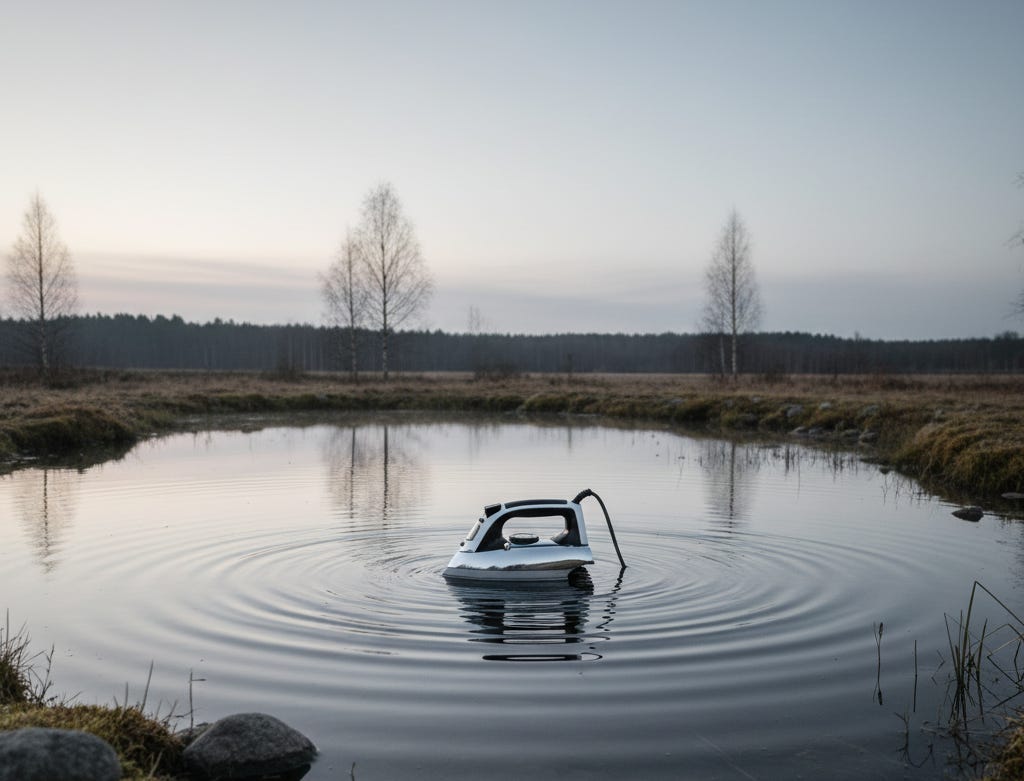
As we discussed in previous posts, desiring to eliminate desires is a loop that goes nowhere. Similar to trying to use an iron to flatten ripples on a pond’s surface, the effort actually makes things worse. The above two bullets are sneaky, but common ways that old patterns of the average successful person will manifest themselves and attempt to help in the new paradigm. However, they are misguided.
Both setting “being present” as a goal and not feeling satisfied until you’ve “achieved” it, and building out systems to try and meet this goal can confuse people into reverting back to where they started (unfulfillment).
For example, to avoid the first old pattern we mentioned (your objective function becoming the old version of a goal), you may set up systems that use “the fix.” You could have a mandatory re-read of the posts covering Step 1 of this Substack every morning. You could monitor “how present” you feel each morning. You could estimate how many repetitions of this until you get to the highest score of presence available and track your progress against it. If you’re not there or behind schedule, you’ll feel like you need to do more, build a more intense system. Review the Substack twice a day instead of once. That doesn’t work, you’re now way off track and things feel really bad. You thought you had the answer, but clearly it’s not working, something’s wrong. I need to go back out there and search for the real solution. …. sound like something you might do?
As soon as you’re reaching for a system, you may want to check if you’re starting to make your happiness/fulfillment contingent upon something.
Fixes:
Remember that as soon as you believe that something needs to change*, you’ve introduced a desire that will need to be met before you’ll feel happy/fulfilled. This includes seemingly helpful things like being more present. As soon as you believe that you’re not present enough, you’ve lost. You’ve put happiness/fulfillment out in the future. Therefore, more control and more systems are not the right tool for the job. When facing this particular struggle, they can reinforce the very paradigm that you’re trying to overcome.**
The “Wanting What’s Happening” solution from The Capability post also works here. If you’re worried that you’re drifting without a system - like that you’re worried. If you notice that you’re building too many systems and regressing to your old goal-oriented self, like that you’re regressing. As soon as you notice yourself needing something, like that you don’t have it.
*For you advanced overthinkers: paradoxically, not even you thinking that things do need to change, needs to change. If you like that you’re looking at things the “wrong way”, it’s suddenly not a problem (or a desire that needs to be fulfilled).
**Note that this is not to say that systems/control aren’t helpful in our new, present context. In fact, it’s probably the #1 thing that helps people that are already far to the right on the “presence” spectrum.
What does this actually look like in practice?
Tying this directly into the context of Rational Enlightenment and the previous posts, being present/accepting the present/being free from desires is where you will mostly (90% of the time) “live.” This is what fills you with energy, joy, fulfillment, appreciation, and the feeling of having loads of time. The 10% of time is where you address all of your likely fears about switching from your past default mode (95% thinking). It’s where you can set goals, prioritize things, engage in metacognition, evaluate other options, introspect and reflect and plan for the future. Perhaps most importantly, it’s where you set the direction of your life.
Throughout these posts, the importance of this 10% of time has been understated. This is because my target audience already has this type of thinking/planning as a massive strength - it’s the being present bit, which is almost everything in the new paradigm, where they struggle. That being said, this 10% is crucial and what transforms dumb enlightenment into Rational Enlightenment.
Contrasting paradigms
What about the nitty gritty? Let’s juxtapose what a typical day-in-the-life looks like from the old and new paradigm.
Tuesday on Autopilot (95%+ thinking - the old paradigm)
You wake up already thinking.
There’s a vague sense that you’re behind - not dramatically, just enough to be uncomfortable. While getting ready, your mind is running through the day, what needs to be done, what you should have done already, what you’re slightly worried you’re neglecting.
On the commute, you’re scrolling or planning or half-rehearsing conversations. You arrive at work and sit at your desk, but it takes a while to actually start. There’s a faint backdrop of anxiety. You may bounce your leg or tap your pen. You open a document, get distracted, check messages, think about how much there is to do.
Work feels like something to push through. Even when you’re productive, there’s a background tension: Is this the right thing to be working on? Am I doing enough? You’re motivated, but it’s effortful.
By the end of the day, you’re tired in a way that isn’t purely physical. There’s relief that it’s over, and a quiet sense that tomorrow you’ll need to do it better.
You briefly consider if you actually did do enough and that you could be content, but a small voice in your head screams that that would be complacency and you’re already behind. So, you resolve to try and do more tomorrow.
Nothing was wrong.
But nothing felt fully alive either.
Tuesday Fully Engaged (90% present - the new paradigm)
You wake up, and you’re here.
There’s no immediate mental sprint. Getting ready is just getting ready. Although you’ve looked at the same walls of your bedroom or stood in the same shower many times, it’s a new day and there are subtle differences in the experience that give you a vague sense of satisfaction and contentment.
This continues into your commute. You notice people, light, and small details without trying to. There’s no sense that life is waiting to start. This is it.
You sit at the same desk, open the same laptop, and begin working. Focus comes more easily, not because you’re forcing it, but because attention isn’t split. Tasks unfold one at a time. Even the mundane parts feel oddly engaging - not exciting, just… present.
At some point, stress inevitably shows up. A deadline, a tricky conversation, a tough choice or tradeoff. You feel it fully without adding a story about it. “Ah. This is what stress feels like… interesting!”
Then you continue.
Planning happens briefly and deliberately. You decide what matters, make a few adjustments, and then return to what’s in front of you. You don’t compulsively return to the plan to see if there’s a better plan. You realize that acting on a decent plan is better than never acting on a perfect plan. Most choices are pretty straightforward when you run potential outcomes by your Objective Function.
Conversations feel warmer. You’re less guarded with appreciation. Small talk drops away faster. It feels like you’re talking to a person, not managing an interaction.
By the end of the day, you’re not waiting for relief. There’s a quiet satisfaction. Not because everything went perfectly, but because it’s your life and you experienced it. You were actually there for it.
And you like where it’s going.
The Journey
You’ll notice that it’s the same Tuesday, with the same responsibilities, but a very different experience. Here are some more ways things may feel different in practice under the new paradigm of presence:
Vivid rather than muted
Engaging rather than effortful
Spacious rather than rushed
Alive rather than procedural
Ordinary moments carry a sense of depth that wasn’t there before

People can often describe this as:
“I feel like myself again”
“This is how life is supposed to feel”
“I didn’t realize how numb I was”
Some of you may already be thinking “Okay how do I actually get to 90% presence, what does that process look like?”
To you I say: You’re probably fixating too much on getting to 90%. Let’s imagine you’re at 20% presence. When you’re present, you won’t be upset that your overall percentage of time isn’t higher. You’ll be occupied enjoying the present or working in a state of flow. The same is true if you’re present only 1% of the time. You might think it would be nice if more of your life was like this, but worry - worry only comes from the planner. “I’m not present enough.” “I need to do more to become more present.” This takes away from presence rather than building it. The good news is it can be solved by simply remembering that you’re trying to use the iron to smooth out ripples, which is not the right tool for the job.
This can trigger a defeatist throwing up of the hands. “Okay, so I’ll just do nothing then? Never improve?” …Shhh shh shh. You can improve, but white knuckling it (i.e., more forcing and control) won’t work. Under the new goal paradigm (something you want to experience), this can be fully addressed in your 10% planning time. The question is more like: “how can I encourage/support more presence without needing it to happen?”
A seemingly silver bullet for this particular problem is - you may have guessed it by now - the “Want What’s Happening” solution from Step 1. If you’re not at 90% presence, like that you’re not there. Like that you haven’t made any progress in 2 weeks. This ostensibly anti-goal behavior or thinking somehow reaches the goal faster than more systems, more control, or more discipline ever can!
Decades of habits (e.g., autopilot) will leak, for a while, into your pursuit of objective function and, indeed, your life. It can be very easy to be unengaged when you’ve spent most of your life in that state. This can also lead to some confusing questions: “Should every moment feel like bliss? Should I be concerned if I don’t feel amazing?” The short answers are yes and no, respectively. I know you probably won’t believe me, but feeling amazing is a sign that you’re doing it right, but not feeling amazing is not a sign that you’re doing it wrong. The only thing you can do wrong is thinking that you’re doing it wrong. If you’re searching for bliss, you’ve lost. It’s right under your nose. Ditto for searching for “the right way.” The right way is not searching. Don’t forget that you’re done! …if you want to be.
Conclusion
Let’s recap where we started and where we are now.
The people I’m targeting will have started reading this series of posts looking for the answers given in Step 1 (happiness/fulfillment).
I believe that there can be even more than this happiness/fulfillment. It’s all the things you can do from that state - filled with feelings of infinite possibilities and having loads of time on your hands.
Really these are the main points I want to get out there. Steps 3-4 are more about doing this without slipping back into suffering/constant striving without ever quite making it to fulfillment or slipping into “dumb enlightenment.”
So now you have what you thought you wanted (happiness/fulfillment), the realization that there’s an exciting world beyond that, and some tools/guidance on how to explore that big new world without falling into common traps.
The balance is much more of a change than you perhaps originally imagined. More specifically the experience of the balance. As we said before, the behavior doesn’t necessarily need to change dramatically (although it can), but the experience of it will. If you adopt Rational Enlightenment, 90% of your time will be in a new mode of living. That is a huge change. It’s not likely to become your default mode over night. For me, instead of a daunting change, this reinforced that this is the thing we’ve been looking for. If you really were searching for something (fulfillment), did you really just want a sprinkle of it every once and a while, or did you want something bigger?

Now go forth and enjoy your one wild and precious life.