
Immediate Happiness - The Capability
That sounds nice.

In the previous post we established that: no desires = happiness. This is what we’ll be building on in this post, so please go back and read it if you disagree. If this claim is true, the obvious next question is how we can get rid of desires in practice.
In this post I’ll give you four practical techniques on how to actually do this beyond the typical and vague recommendations to “be present”, including the one I successfully use on a regular basis. I’ll go into some meta-level points for anyone that is struggling with the techniques, and I’ll gesture at how this fits into the larger frame of Rational Enlightenment.
Techniques for removing desire
Technique 1: Recognizing the Chase

Let’s do this one live.
Ask yourself: “What do I want right now that I don’t have?” Be specific. Not “I want to be happy” - that’s circular. What actual thing do you want? Maybe you want to finish this article. Maybe you want it to be Friday. Maybe you want your apartment to be cleaner. Maybe you want a text back from someone. Pick one. Got it?
Ask: “What would happen if I got this thing?” Really think about it. Your mind will say “I’d feel good!” But look one layer deeper. Would you be completely satisfied forever? Or would a new desire appear soon after? Be honest.
Recognize the chase: Getting what you want doesn’t eliminate desire, it just shifts it to a new desire. When the text comes back, you’ll want it to say the right thing. When Friday comes, you’ll want Monday to not come. You've been doing this your entire life. Desire —> fulfill —> new desire —> fulfill —> new desire. The queue never empties.
Now that you see the loop, ask yourself: “Can I want what is actually happening right now instead?” Not pretend to want it. Not force yourself to like it. Just genuinely ask if it’s possible to want the reality that already exists. Sitting here, reading these words, feeling however you feel.
What it should feel like:
When done correctly, you’ll feel a kind of relaxation. Like you’ve been clenching a muscle you didn’t know was tense and you finally let it go. The situation hasn’t changed, but your relationship to it has. You’re no longer fighting reality.
If you felt something (even faintly), that’s it. Rational Enlightenment (the rest of this series) aims to crank that feeling up as high as it goes. If you felt nothing, keep reading. The techniques below approach the same idea from different angles, and the section on the Damning Irony addresses why “trying” can itself be the obstacle.
Technique 2: Present Moment Inventory
Stop whatever you’re doing. Literally pause.
Take inventory of what’s actually happening right now in your direct experience. Not your thoughts about what’s happening. Not your story about your life. Just what’s actually happening. Examples:
Sensation of breathing
Sounds in the room
Visual field in front of you
Physical sensations in your body
Temperature of the air
Notice: Is anything actually wrong with these sensations themselves? Not “my back hurts and I don’t like it” - but is there something inherently wrong with the sensation itself, separate from your story about it?
Expand this: In this exact moment, with no story attached, what problem exists? Don’t think about the future (the meeting coming up, the deadline tomorrow). Don’t think about the past (the argument this morning, the mistake last week). Just this moment…
.
.
.
Is anything actually wrong?
What it should feel like:
You should notice that right now, in the immediate present stripped of all narrative, there’s actually no problem. The “problems” only exist in your thoughts about past and future. This isn’t about pretending issues don’t exist - they do, and you’ll address them (more on that in Step 3) - but you’re seeing that the present moment itself doesn’t come with those baked in.
Technique 3: Wanting What’s Happening
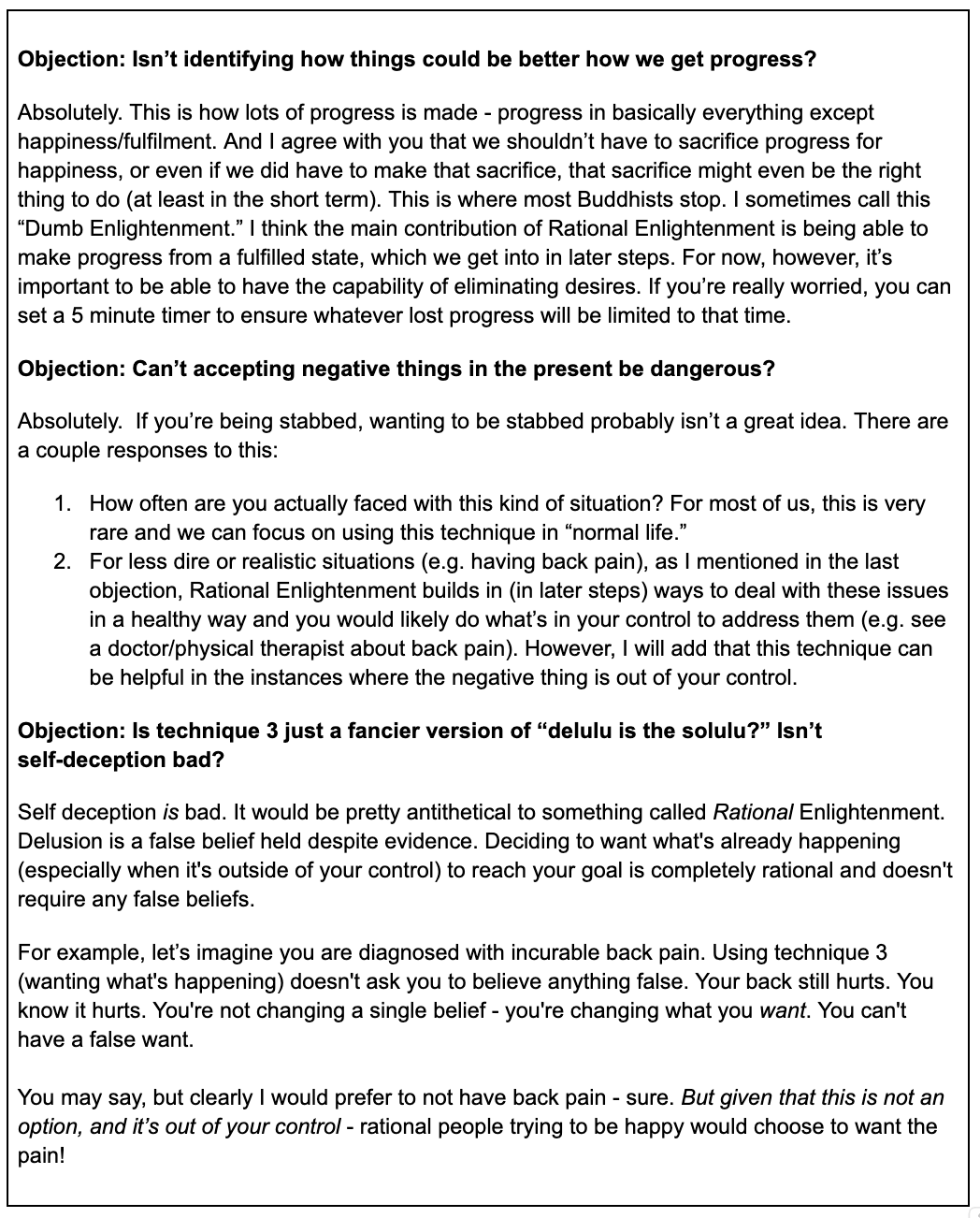
There are some caveats and background needed for this one (common objections are also addressed in the box below). The background understanding is that nothing exists outside of the present. The past is contained in memories that are conjured in your mind in the present. The future also exists in the imagination. If today is Monday, the coming Friday exists in our minds in the present. When Friday does come around it will come around as the present. You can never experience the future, or the past, only the present (if this doesn’t make sense, I’m planning to write a post that dives deeper into this and provides additional resources in the future).
Desires are typically for things that aren’t in the present. Using this as a background, to eliminate desires, one approach is focusing on what is already here. Many people are programmed, when looking at the present, to immediately think of ways to improve it or how it could be better. This habit is pretty deeply ingrained and pretty difficult to overcome. This technique is a way to interrupt this pattern.
Only 1 step for this technique:
Actively like and want whatever is happening in the present.
Let’s try it right now. Start with what’s easy:
You’re reading. —> Want to be reading.
You’re breathing. —>Want to be breathing.
You’re sitting somewhere - a chair, a bed, a train. —> Want to be sitting there.
Notice what happens. There’s probably no resistance at all. Why would there be? You’re already doing these things.
Now push it slightly. There’s probably some minor discomfort available - your posture isn’t perfect, you’re slightly hungry, the room is a bit too warm. Pick one.
Now, want it.
Not “tolerate it.” Not “accept it for now.” Want it.
Fun, right? Let’s push even further. Something is bothering you today - perhaps something unresolved or something you’ve been carrying around. Not your worst problem, but something that’s been tumbling around in the back of your mind with a feeling that “this needs to be different.”
Want it to be exactly as it is.
If we remember the logic of the argument in the previous post, happiness = no unmet desires. This technique works because wanting what’s already happening only creates desires that are immediately met. Furthermore, by focusing on what already is, you interrupt the regular pattern of thinking about things outside the present (which would create an unmet desire).
What it should feel like:
This creates an immediate peace. The war between reality and your preferences stops. You “team up” with reality and whatever happens to be happening at the moment. And paradoxically, from this place of complete acceptance, you often take better action because you’re not acting from resistance and desperation.
In my personal implementation of this, I also sometimes felt somewhat playfully aggressive towards… the universe? Towards life? “Oh, you’re gunna try and make me sad by stubbing my toe? Jokes on you, I actually looove stubbing my toe.” A strange sticking-your-tongue-out attitude usually reserved for quarrelling children.
Technique 4: Putting Things In Perspective
This is one that I use all the time. It often springs to mind anytime someone asks “how’s life”?
The normal (unfulfilling) process might be something like:
Score how your life is going on a scale of 1-10
Ask “what is keeping it from a 10?”
Focus on those things and pursue them
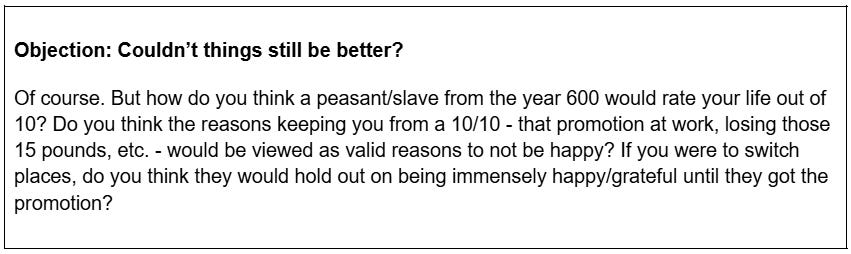
To put things in perspective, you can ask yourself some questions before answering how life is going:
When was the last time you had to personally fight in a war or put your life on the line?
When was the last time you had to hunt for food?
When was the last time you had to use a chamber pot to go to the bathroom? (or dodge a chamber pot being emptied out the window, or walk along the open river of sh*t this practice used to create)
When’s the last time you spent a winter in a cave trying to stay warm?
Now think about “how’s life?”
The things that we modern humans might be focusing on and complaining about can be relatively trivial. Human civilization is nothing short of an amazing feat. The myriad of comforts and marvels of modern technology abound.
Some of you will realize that this is basically just immense gratitude for how well we have it compared to almost all of human history.
What it should feel like:
For me, this usually gives a wave of gratitude and relief and a renewed sense of appreciation for many things I take for granted. It can also sometimes make me feel silly about things I’ve been fixating on as “problems.” Perhaps less relevant, it also gives me a deep respect and sympathy for all the generations that came before us.
For most people in developed western democracies, whatever problems we face, I’d rather face them than having to deal with getting a spear thrown through my leg with no pain meds.
A Damning Irony?
If the above techniques are working for you, don’t read this section and skip ahead to the conclusion. This section is for people that may be diligently trying the above techniques, or others that they’ve come across, but to no avail.
We established that a lack of desires = happiness. So all we need to do is eliminate desires and we’ll be happy…
But some of you may have already realized that there’s an immediate problem here. Isn’t wanting to eliminate desires a desire itself? Isn’t not wanting to have that desire also a desire? It seems there’s no escape! And there’s the bind. This is why so many people seem trapped. This is why perhaps those who desire happiness the most and are most diligent about the above exercises are no closer to happiness, but indeed closer to exasperation. This is also why, from my perspective, so many people bounce off of meditation or mindfulness. They take it up because they want it to make them peaceful, to make them content. But by having that desire, they immediately guarantee that they won’t be satisfied.
“I desire to eliminate desires.”
Circuitous and impossible to resolve by doubling down. This is where the diligent people run into trouble and where there is a massive irony. “I just need to try harder to eliminate desires.”
The good news is that it is not a damning irony. However, the escape hatch is one that diligent people will struggle with and one that is often neglected as an option: doing nothing.
You’re already there.
Doing nothing sounds useless until you see the structure behind it - trust me, I hated this idea at first, too. This isn’t mystical surrender; it’s simply a truth about how systems behave when effort is the wrong tool.
The more you try to fix your internal state, the more you reinforce the belief that something is wrong.
“But something is wrong!”, you scream, the issue is there!
An analogy that helped me was the crazed man trying to smooth ripples in a pond using an iron. It may be true that there is something wrong if you hate ripples and you see some in the pond. However, every time you try to smooth them with your iron, the more turbulence and ripples you create. The great irony here is that the first ripples to appear were also caused by your iron! You just didn’t notice until much later. The appropriate thing to do in this situation, obviously, is to not do anything. Working harder to fix it with that tool is clearly not the right approach.
And so it is with desire:
You can’t get rid of the feeling of wanting to get rid of something by wanting to get rid of it.

You don’t need to add anything (including the desire to take things away). This is why the whole situation is so ironic. Everyone thinks they need to work or strive for happiness, but it’s right there, immediately available with no work at all - ludicrous!
Happiness is already there to be found or rediscovered. It’s not a future destination. As soon as you start searching for it, the game is lost.
Nothing else is required.
The peace you wanted wasn’t missing.
It was just hidden under your attempts to create it.
You’re already there.
Conclusion
Okay, so now we realize that happiness is immediately available and have a couple of techniques to actually be capable of feeling and accessing the happiness (rather than just knowing that it’s available).* Or better yet, we realize that we don’t need to add any techniques and that “we’re already there.”
As transformational as this realization can be, it is just Step 1. The foundation to build on top of.
The next step is to realize that, despite so many people pursuing it, happiness isn’t actually the goal.
Which is the topic of the next post.
*If you accept that in theory not having desires = happiness, but are still struggling to get rid of basic desires in practice (i.e. the three techniques above aren’t working for you), I plan to dedicate a post in the future to a much deeper dive on how you can do this.